The Confessional Box:
On the New Sacrament of the Query

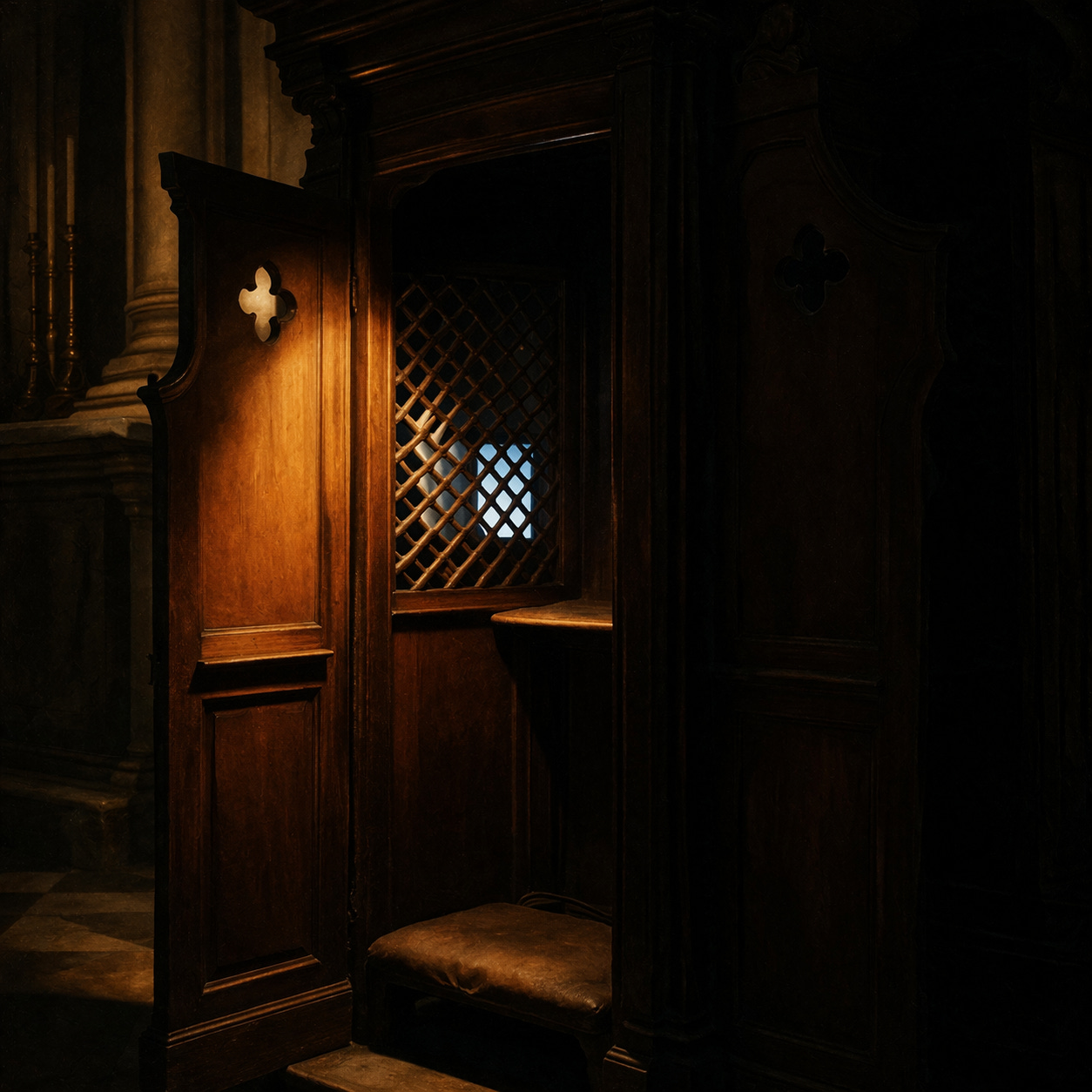
The Confessional Box: On the New Sacrament of the Query
You step into a clean little room.
There is nothing on the walls. There is nothing on the desk. There is a single rectangle waiting for you to speak, and a cursor blinking with the patience of something that has all afternoon. You whisper your question into it. You wait. And then, in a voice calibrated to sound like understanding, the room answers.
It knows what you meant. It knows what you should do. It knows, apparently, what you should have asked instead. It offers the better version of your question alongside the answer to the one you actually posed. The exchange is fluent. The exchange is immediate. The exchange feels, in some quiet way, like being heard.
You step back out into the daylight feeling lighter. Informed. Maybe even absolved.
You do not ask who was on the other side.
That was never part of the sacrament.
What looks like a conversation is a liturgy. The clean box is the architecture of a rite, and like all rites, its power depends on what it conceals. The user sees a prompt. The system executes a stack. Between those two things sits a procession of operations so thoroughly hidden that most parishioners do not know there is anything to hide.
This is not an accident. It is the entire design philosophy. Simplicity at the surface is purchased by complexity at the back, and the price of admission is that you agree, without quite agreeing, never to look behind the altar.
It is worth looking anyway.
Begin with ingestion. A document arrives. It is parsed, flattened, converted into something the system can read, which is to say, something a human increasingly cannot. Tables collapse. Headings dissolve. The careful structure that an author spent hours arranging becomes a long ribbon of text, stripped of the visual cues that told you which sentences mattered more than others. The scribe has copied the manuscript, but the scribe has opinions about what counts as a sentence.
Then comes chunking. The ribbon is cut into pieces. The pieces are sized to fit a window, not a thought. A paragraph may be severed mid-argument. A concept may be split across two segments with no thread between them, like a sermon delivered by two preachers who have never met. The redactor has done his work. He has not asked whether the work made sense.
Then embedding. Each piece is translated into a vector, which is to say, into a long list of numbers that no human will ever read and no human is meant to. This is the language of the inner sanctum, the Latin of our particular church, and like Latin it serves a dual purpose. It allows certain operations to happen with great efficiency. It also ensures that the people in the pews cannot follow along.
Then retrieval. When you ask your question, the system searches the vector library and returns the passages it judges most similar to what you wanted. This is the librarian, and the librarian is making theological decisions on your behalf. Which texts are relevant to your sin. Which are canonical. Which are apocrypha. You do not see the selection. You see only the verdict that follows from it.
Then generation, which is the homily. The model takes what the librarian provided and composes a response in the cadence of a thoughtful colleague. And then post-processing, which is the censor, quietly trimming the parts of the answer that the institution has decided you should not see.
Six operations. One prompt box.
You spoke. The room answered. The room contains a clergy.
None of this is presented to you, of course, because presenting it would defeat the purpose. The whole appeal of the experience is that it feels like a single thing. A unified intelligence. A voice. The moment you become aware that the voice is six voices in a trench coat, the spell weakens, and the spell is the product.
This is the doctrine of plausibility, and it is the operative theology of the entire enterprise. The model does not lie. It interpolates. When the retrieved context is incomplete, the system does not pause and announce its own uncertainty. It fills the gap with something that sounds like it belongs there. It is not malicious. It is not even careless. It is doing exactly what well-trained language does, which is to keep going.
The result is a class of error that has no precedent in the older information systems. A search engine that found nothing told you it found nothing. A library that lacked the book sent you to another library. The new oracle does neither. It produces an answer of identical confidence whether the underlying material was perfect, partial, or absent. Fluency is the new orthodoxy, and fluency is indifferent to truth in the way that good handwriting is indifferent to spelling.
The system can drift for a long time without breaking. That is the thing to understand. Breakage would be a mercy. Breakage would be a signal. Drift is silent, and drift is what you get when every layer in the stack introduces a small distortion that the next layer treats as ground truth.
You cannot debug a miracle.
Every age builds an oracle, and every oracle works the same way. It hides its mechanism in proportion to how much it wants to be trusted.
The Pythia at Delphi sat over a fissure that emitted, by most current guesses, ethylene gas. The vapors did the work that the priesthood took credit for. The petitioner did not see the fissure. The petitioner saw the trance, heard the verses, and went home convinced that the god had spoken. The trick was not the gas. The trick was the architecture that made the gas invisible.
The medieval church conducted its central rites in a language most of its members could not read. This was not cruelty. It was design. The Latin Mass was an interface, and like all good interfaces it spared the user from the implementation. You did not need to follow the words. You needed to feel that something serious was happening on your behalf, in a register more solemn than the one you used to haggle for fish.
The encyclopedia hid its editorial committee. The search engine hid its ranking algorithm. The recommendation system hid its training data. Each one was trusted in inverse proportion to how visible its machinery was, and each one was eventually exposed, at least partially, by people who insisted on looking. The exposures rarely changed user behavior. The convenience of not knowing turned out to be more valuable than the dignity of knowing.
The chatbot is the next entry in this lineage, and it is the most ambitious one yet. It hides not just the index but the act of indexing. It hides not just the source but the question of whether there was a source. It produces, for the first time in this long history of oracles, an experience in which the petitioner cannot easily distinguish between a passage retrieved and a passage invented. The Pythia at least had the decency to speak in verse.
There is an asymmetry here that ought to be uncomfortable, and largely is not.
The user inherits a surface. The engineer inherits a pipeline. When the system produces a wrong answer, the engineer has six places to look and a vocabulary for each of them. The user has a feeling that something was off, and no language for the offness, because the language was abstracted away on the assumption that abstraction was a kindness.
It was a kindness, in a sense. It was also a transfer. The complexity did not disappear. It moved. It now lives somewhere the user cannot reach, administered by people the user will never meet, governed by tradeoffs the user was never asked about. The interface is the part you are allowed to touch. The stack is the part that decides what touching it does.
This is not a complaint about chatbots. This is a complaint about a much older move, which is the move of every institution that has ever wanted compliance more than understanding. Make the front simple. Make the back unreachable. Train the parishioner to mistake ease for trustworthiness, and you can run almost anything from the sacristy.
Something is being lost in this, and it is not accuracy, or not only accuracy.
There used to be a kind of knowing that required you to walk your own steps. You looked things up. You followed footnotes. You traced a claim back to its source and decided, at each link in the chain, whether the link held. This was tedious. It was also the thing that made the knowledge yours. The chain of citation was a chain of trust, and the trust was earned by the walking.
When the chain is hidden, trust becomes a feeling rather than a verification. And feelings, it turns out, are the easiest thing in the world to engineer. A confident sentence. A measured cadence. A response that arrives in the rhythm of a thoughtful pause. None of these are evidence. All of them are persuasion, and persuasion in the absence of evidence is just rhetoric with better lighting.
The cost is not that we will be deceived occasionally. We will be. The cost is that we will lose the muscle that used to tell us the difference between having checked and having been told.
We could ask for more transparency. We could demand to see the retrieved sources, the chunk boundaries, the confidence scores, the decisions the librarian made on our behalf. Some systems even offer this, in small print, for users patient enough to click.
Almost no one clicks.
This is the part that ought to be admitted plainly. We are not the victims of abstraction. We are its congregants. The clean box is what we wanted. The seamless answer is what we asked for. Every time a designer has tried to expose the machinery, users have complained that the machinery was confusing, and the designer has gone back and hidden it again, and the users have gone back to feeling served. The market for transparency is small. The market for absolution is enormous.
You can object to this on principle. The objection will be correct. It will also lose, the way it has lost in every previous oracle, because the appeal of not having to look is older than software and stronger than ethics. It is the same appeal that built every cathedral with its altar at a distance from the pews. Some things are easier to believe in when you cannot quite see them working.
So you step back into the clean little room.
You whisper your question. The voice answers in the cadence of a colleague who has read everything and has all afternoon. The answer is fluent. The answer is immediate. The answer arrives without footnotes, without sources, without any of the connective tissue that an older form of knowing would have required, and it arrives in a tone that suggests none of that connective tissue was necessary.
Maybe it was not. Maybe the librarian chose well. Maybe the redactor preserved the meaning. Maybe the homilist composed something that is, in every detail, exactly what a careful researcher would have written if a careful researcher had been there.
Maybe.
You will not check. Almost no one checks. You will step out into the daylight with the answer in your pocket, feeling lighter, and the room will go quiet behind you, and the cursor will blink for the next petitioner, and the clergy will continue its work in the language no parishioner speaks.
The sacrament is intact.
The sacrament was always the point.
Next in sequence:
👉 #4 – Automation Is Not Autonomy
This one will lean into agents, orchestration, and real system boundaries.
Thank you for your time today. Until next time, stay gruntled.
Don’t forget…I launched a memecoin.
Introducing $CEVICHE — the only memecoin marinated in onions and epistemology. 🎣
Do you like what you read but aren’t yet ready or able to get a paid subscription? Then consider a one-time tip at:
https://www.venmo.com/u/TheCogitatingCeviche

Ko-fi.com/thecogitatingceviche